Axolotl Care Sheet
Description
Ambystoma mexicanum, or more commonly known as the Axolotl or Mexican Walking Fish - is actually not a fish at all - rather an amphibian (salamander to be specific). Axolotls are part of the order Caudata/Urodela. They originate from the bottoms of two lakes in Mexico, but don’t be fooled - the lake was fed from a large glacier and remained cool throughout the seasons. Thus, axolotls require cooler water temperatures than most would believe. Axolotls have since been deemed an endangered species in the wild, and are now bred and thrive in captivity. The Axolotl’s life cycle is a rare phenomenon as they live their entire lives in the larval stage, yet still, manage to breed. “It is believed that they have evolved to be this way due to low levels of iodine in their native waters. Experiments have been done and Axolotls will metamorphose when exposed to iodine, and they develop into salamanders that look similar to the closely related Tiger Salamander. Axolotls have excellent regenerative abilities and can regrow limbs, tails and even heart and brain cells at an outstanding rate. This has made them a popular focus in scientific research.” [theamphibian.co.uk]
Main Morphs (Colourations)
There are several different colour variations [morphs] in Axolotls that occur in captivity, sourced in more detail from A Lot’l Axolotls.
- Wild Type: Dark, mottled brown with shades of green, tan, or olive, gold iridophore speckles, and a metallic gold ring around the pupil.
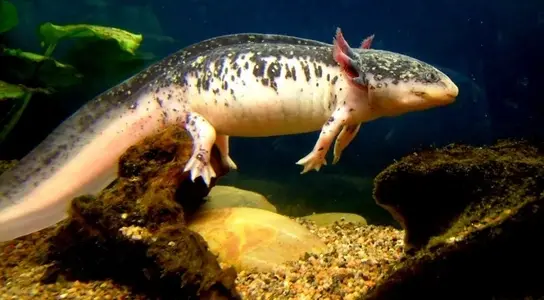
- Leucistic: Predominantly white or pale pink, with black or dark-navy eyes and bright red/pink gills. May or may not develop freckles.
- White Albino: White or very pale pink with red or clear eyes, and pale, feathery gills with bright red/pink filaments.
- Golden Albino: Luminous golden-yellow to light tan, with red or clear eyes and matching golden or pinkish gills.
- Melanoid: Dark, uniform, matte black or very dark grey — no shine, no speckling, and black eyes.
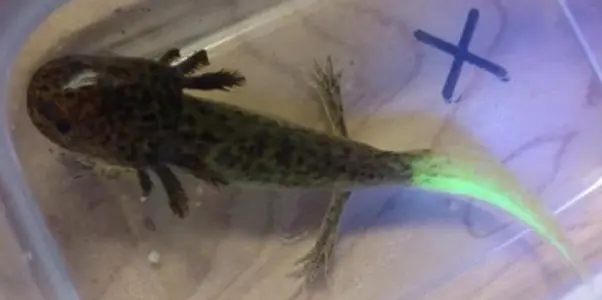
- GFP: Any base morph carrying the Green Fluorescent Protein gene, which glows bright green under UV or blue light.
- Copper: Copper or light brownish-orange, with red-tinted eyes; lays white eggs.
- Chimera: Extremely rare — bilateral symmetry where one side of the body is a completely different colour from the other.
- Silver Dalmatian / Lavender: Pale, silvery lavender with dark spots or speckles and dark eyes.
- Enigma: An irregular mix of colours and patterns — black, white, gold, grey, and patches of others — unique to each individual.
- Mosaic: Patchwork colouration from genetic mosaicism, with irregular, random patterns unique to each individual.
- Piebald: Large unpigmented white/pink patches mixed with pigmented sections, randomly distributed and unique to each individual.
- FireFly: A lab-produced rarity with a dark or black head and body, and a bright fluorescent green tail.
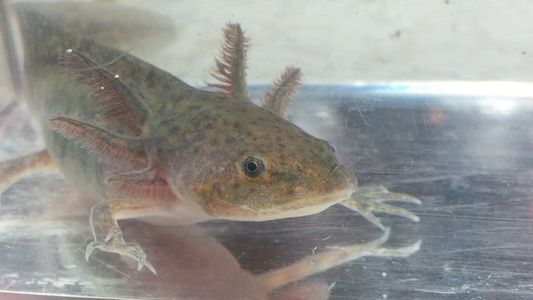
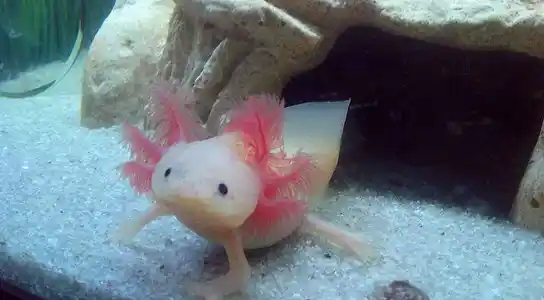
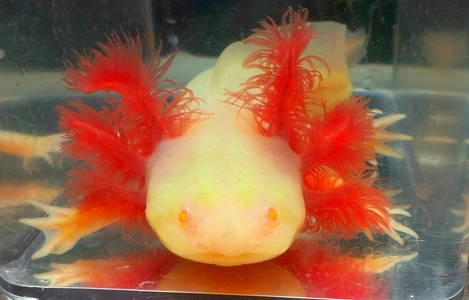
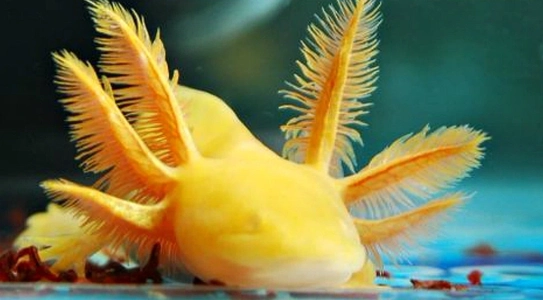
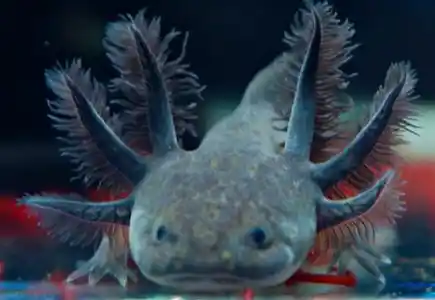
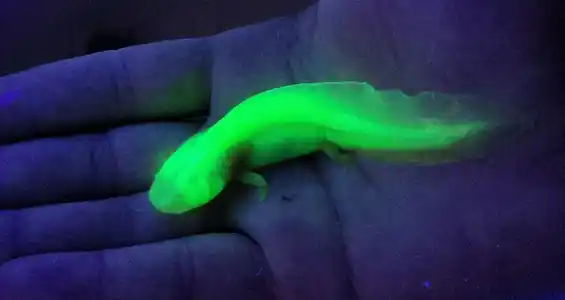
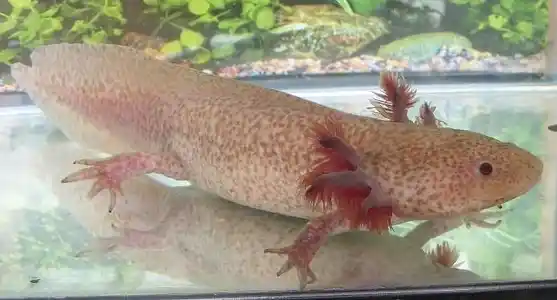
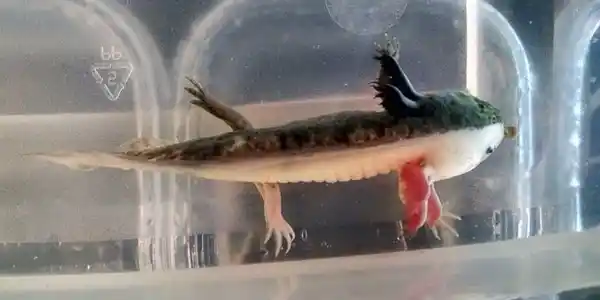
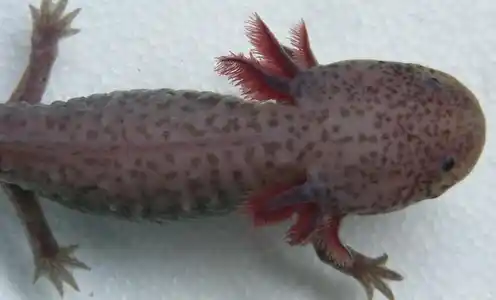
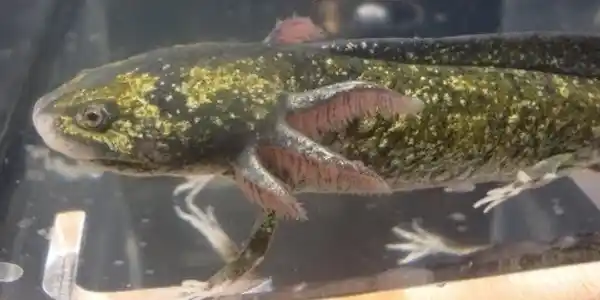
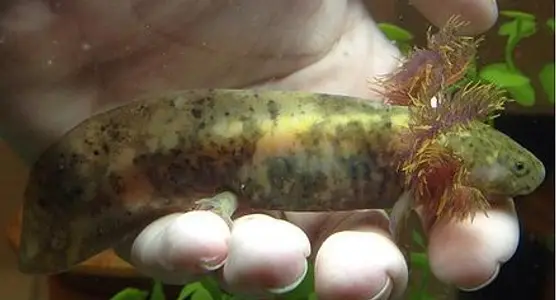
For the full write-up on each morph, see Different Types of Axolotls: Morphs and Colour.
Size
Axolotls can grow up to 25-30cm (10 - 12 inches). Dwarves at around 7 inches.
Life Span
Axolotls can live up to 15 years with appropriate care, but generally clock out at about 10 years.
Habitat (Very Important)
An aquarium will be required to house an axolotl, as they are an entirely aquatic species that enjoy heavily vegetated freshwaters. Axolotls are quite an active species, so the bigger the aquarium the better. Axolotls require at least 10 gallons each when adult size is reached. The aquarium should be fitted with a tight mesh or screen lid, as they are prone to try and leap from their enclosures.
- Axolotls are NOT adapted to live on land; they dehydrate and can die very quickly if they are not in the water at all times. It is possible to handle your axolotl once in a while as long as they remain in the water, but it is advised not to as the axolotl has a protective slime covering their body, and handling could damage him/her.
- The bottom of the tank may be lined with aquarium or play sand (make sure to rinse prior to putting it into your tank); you can also leave it bare if you wish. Avoid any gravel or rocks as the axolotl can ingest these and DIE.
- If you do not have a gentle filter in your tank, daily water changes are required to keep bacteria and ammonia (found in axolotl excrement) levels down. Axolotls require a low-flow filter because they become stressed if the water output flow of the filter is too strong. With a filter, it should only be necessary to change 1/3 of the water every week in a tank 20 gallons or less. In a bigger tank (20gals+) 50% water change should be performed once a month. A sponge filter should be used for axolotls smaller than 5 inches, a small regular filter can be used when they’re 5” plus.
- De-chlorinated water should always be used for your Axolotl as they are very sensitive to various chemicals and cannot handle water with chlorine/chloramines. Water should be kept at a PH level of around 7. PH levels should be checked after each major water change to ensure that a similar PH is always maintained.
- Axolotls require somewhere to hide and can become stressed if this is not provided. This can include plants, logs, large rocks, flowerpots, and aquarium ornaments you can purchase at your local fish store.
Temperature
The ideal water temperature for your Axolotl is a temperature gradient of 16-20°C (60-68°F). This is generally around room temperature so no additional heating should be required. In most cases, hobbyists experience difficulty keeping their tank cool in the warmer months. Lower temperatures lead to sluggish behaviour, slower metabolism, and decreased appetite. Temperatures above 24°C (75°F) are very stressful to axolotls. Such temperatures cause metabolism to increase and consequently, an increase in appetite. Stress resulting from more than a day or two of exposure to these temperatures will quickly lead to disease and death. It’s useful to have a small thermometer in the aquarium to check the water temperature and avoid any issues with such.
- Avoid using lighting in your tank as axolotls do not have eyelids and are sensitive to bright lights.
Diet
Axolotls are carnivores that should be fed every 2-3 days. They have teeth designed for gripping rather than biting or tearing. Thus, their food is typically swallowed whole; so what you decide to feed them must fit into their mouths. Axolotls should be fed a variety of different foods to avoid boredom with a specific food. It’d be like us eating cereal every day of our lives for every meal - boring! Some examples of appropriate foods to feed your axolotl are bloodworms, earthworms, blackworms, white worms, brine shrimp, daphnia, and carnivore pellets. Feed as much as they can comfortably eat within 10 minutes. We feed our juvenile axolotl’s bloodworms and carnivore pellets. Adults receive all of the above.