Axolotls in Movies, Anime, and Games: A Roundup
Once you start noticing axolotls in media, you can’t stop — they’ve quietly worked their way into games, animation, and franchises well beyond Minecraft. Here’s a tour of where to find them, and how much real biology made it into each portrayal.
Quick answer
Axolotls appear across games, animation and documentaries: Minecraft's tameable axolotls, Pokémon's Wooper and Quagsire, various animated series, and wildlife documentaries on Xochimilco and regeneration. Fiction exaggerates freely; documentaries are the accurate ones.
- Wooper's gills and smile are directly axolotl-inspired
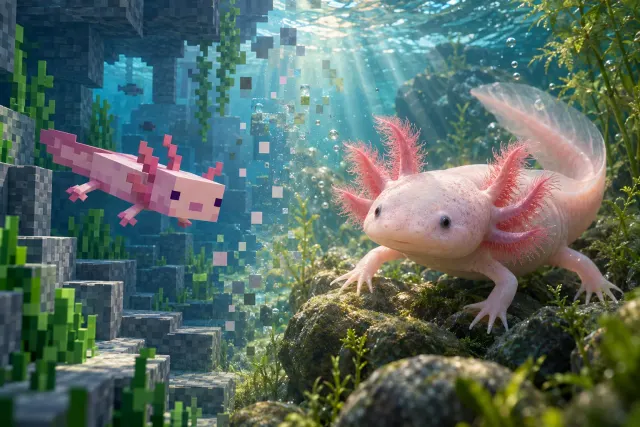
- Minecraft axolotls come in five colours, including a rare blue that doesn't exist in real animals
- Real axolotls don't have blue morphs — that's a game invention
- Documentaries cover regeneration and the Xochimilco crisis most often
Games
Beyond Minecraft (covered in Why Axolotls Took Over the Internet), one of the most recognisable axolotl-inspired designs in gaming has been part of pop culture for decades without most players realising it: Pokémon’s Wooper and its evolution Quagsire are explicitly modelled on axolotls, right down to the feathery external gills and wide, permanently smiling mouth. A newer regional variant leaned even further into the resemblance, cementing axolotls as one of the more recognisable “real animal” inspirations in the franchise.
Animation
Axolotls have shown up as background creatures and character designs across a range of animated shows aimed at younger audiences, usually leaning into the “cute-weird” appeal — feathery gills, big eyes, permanent smile — rather than deep biological accuracy. Some series use axolotl-like characters purely for their visual charm, without engaging much with real axolotl biology at all.
Nature Documentaries
For anyone wanting the real biology rather than a stylised version, wildlife documentary series have covered axolotls periodically over the years, usually focused on either their regenerative abilities or their critically endangered status in Lake Xochimilco. These tend to be the most scientifically accurate portrayals, for the obvious reason that they’re not fictional.
How Accurate Is Any of This?
Fictional portrayals almost always take creative liberties — exaggerated expressions, unrealistic colours, or abilities loosely inspired by regeneration rather than biologically accurate versions of it. That’s fine for entertainment, but it does mean a lot of people’s first “fact” about axolotls comes from a cartoon rather than an actual biology source. If a game or show is what brought you here, our What Are Axolotls? guide is a good next stop for the real version.
Frequently Asked Questions
Is Wooper really based on an axolotl?
Yes — Wooper’s design, especially its gills and mouth shape, is widely recognised as directly inspired by axolotls.
Are fictional axolotls usually accurate?
Generally not fully — most exaggerate expressions or abilities for entertainment rather than sticking to real biology.