Axolotls vs. Other Salamanders: What Makes Them Different
Axolotls belong to a much bigger family of salamanders, and a lot of what makes them special makes more sense once you see them next to their relatives. Here’s how axolotls stack up against the salamanders they’re most often compared to.
Quick answer
Axolotls are mole salamanders (genus Ambystoma). They differ from tiger salamanders by never metamorphosing, from mudpuppies by family, range and biology despite the similar look, and from newts by staying fully aquatic. Their combination of permanent neoteny and strong regeneration is what makes them unusual.
- Axolotl: Ambystoma mexicanum, Mexico, neotenic
- Tiger salamander: Ambystoma tigrinum, metamorphoses, can interbreed with axolotls
- Mudpuppy: Necturus, eastern North America, different family
- Newts: metamorphose; some regenerate limbs too
Axolotls vs. Tiger Salamanders
This comparison matters more than most, because axolotls and tiger salamanders (Ambystoma tigrinum) are close enough relatives that they can even interbreed in some cases. The key difference is neotony: a tiger salamander normally metamorphoses out of its aquatic larval stage into a land-capable adult, while an axolotl — as covered in Neoteny Explained — stays in that gilled, aquatic form for life. Genetically, they’re close cousins; developmentally, they take very different paths.
Axolotls vs. Mudpuppies
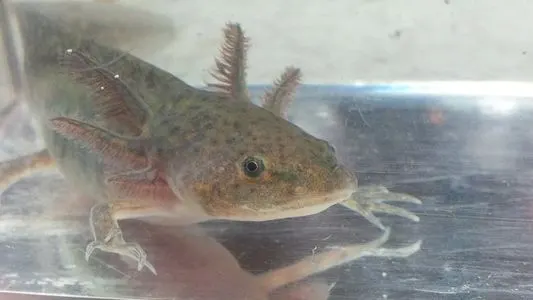
Mudpuppies (Necturus species) are another fully aquatic, gilled salamander that’s frequently confused with axolotls, since both keep external gills into adulthood. The similarity is mostly superficial, though — mudpuppies belong to an entirely different family and are native to lakes and rivers across the eastern United States and Canada, not Mexico. Mudpuppies also aren’t neotenic in the same technical sense; their family doesn’t undergo the same kind of land-based metamorphosis that other salamanders do, so staying aquatic is simply normal for them rather than an exception.
Axolotls vs. Newts
Newts are salamanders too, but the comparison usually comes up because of regeneration — some newt species can also regrow limbs and other structures, making them another popular research model. Newts, however, do metamorphose into land-capable adults and typically move between aquatic and terrestrial life stages, unlike the permanently aquatic axolotl.
Why the Comparison Matters
Understanding where axolotls sit among their relatives makes their two standout traits — permanent neoteny and exceptional regeneration — much easier to appreciate. Plenty of salamanders can do one or the other reasonably well; very few combine both quite as reliably as the axolotl does, which is a big part of why they’ve become the go-to species for regeneration research specifically.
Frequently Asked Questions
Can axolotls and tiger salamanders actually interbreed?
Yes, in some cases, since they’re closely related — though this isn’t common in the wild and raises genetic considerations for anyone working with either species in captivity.
Are mudpuppies just American axolotls?
No — despite the superficial resemblance (external gills, aquatic lifestyle), they’re a different family, native to a different region, with a different developmental biology.
Do all salamanders regenerate limbs?
Many salamander species have some regenerative ability, but axolotls are considered one of the most capable and most-studied examples.